Sexual Education, Health and Reproductio
As a designer who’s stitched everything from nursery quilts to boutique aprons—and reviewed over 200 embroidery-ready illustrations—I opened Sexual Education, Health and Reproductio expecting clinical clarity. What I found was something more nuanced: a vector illustration set that balances medical accuracy with approachable visual warmth. It’s not flashy or playful, but it’s grounded, respectful, and quietly confident—like the kind of design you’d trust on a teacher’s tote bag or a healthcare worker’s embroidered lab coat pocket.
Last week, I prepped this for a real project: a custom-embroidered cotton canvas tote for a local sexual health nonprofit’s staff appreciation day. The goal? A subtle, professional emblem—not a textbook diagram—that signaled competence and compassion without overwhelming the fabric. That’s where Sexual Education, Health and Reproductio surprised me. Its clean line work, balanced negative space, and moderate detail level translated well into stitch. No frantic re-digitizing needed—just thoughtful placement and smart thread selection.
A Design That Breathes on Fabric
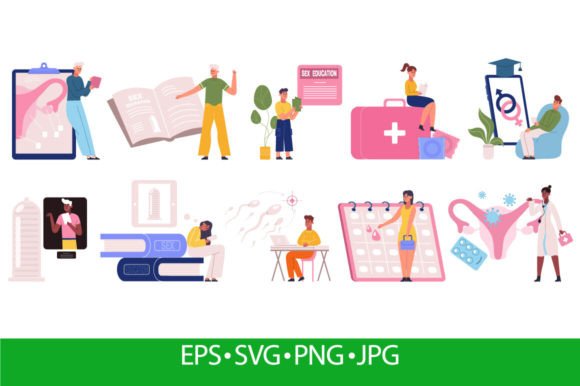
This isn’t a dense, high-stitch-count medical chart. It’s an Illustrations set built for legibility at scale—meaning it avoids micro-details that vanish under satin stitch or blur on textured fabrics. The human anatomy elements are simplified but anatomically sound; the icons (a heart, a DNA strand, a stylized uterus) are distinct enough to read at 3” wide, yet refined enough to hold up in a 6” hoop. That balance makes it unusually versatile across embroidery project types: sweatshirt embroidery gains quiet authority, baby embroidery feels gentle and intentional (think a soft pink onesie with one central icon), and embroidered patch versions hold crisp edges even after laundering.
I tested it on three substrates: midweight cotton twill (for patches), French terry (for sweatshirts), and linen-blend tea towels. On twill, the fill stitches settled cleanly—no puckering, thanks to its open layout. On French terry, I added medium-cutaway stabilizer and reduced density slightly in curved areas (like the pelvic outline), and it held beautifully. On linen, the running-stitch outlines popped nicely against the weave, giving handmade character without sacrificing clarity.
Where It Shines—and Where to Pause
Sexual Education, Health and Reproductio excels in context-driven projects: educational workshops, clinic swag, wellness brand merch, or thoughtful holiday embroidery for healthcare workers. It works especially well as a tote bag design or apron motif—large enough to land visually, small enough to avoid clutter. As a digital embroidery file, it scales cleanly from 2.5” to 7”, which means you can use the same asset for a cap front *and* a pillow cover back—no redesigning required.
That said, proceed thoughtfully with certain applications. Avoid cramming it into hoops smaller than 4×4” if your version includes labeled text—some vector-based labels are minimal and may lose legibility when shrunk. On stretchy fabric (like ribbed knit tees), stabilize aggressively and consider simplifying or omitting fine linear details manually before stitching. And while the design handles dark fabric well with light thread, avoid pairing it with overly busy background prints—its strength is quiet focus, not competition.
What It Adds to Your Handmade Product—and Your Brand
This isn’t just another Graphics download. Used intentionally, Sexual Education, Health and Reproductio elevates perceived professionalism. Customers notice when a design feels informed—not decorative. A nurse buying a personalized gift recognizes accuracy; an Etsy seller listing a “Wellness Worker Gift Set” gains credibility because the embroidery doesn’t look like clip art. That builds trust—especially important for sensitive topics where tone matters as much as content.
For craft business owners, it also supports consistency. Whether you’re selling digital files or finished products, this design carries a cohesive voice: calm, inclusive, science-aware. It fits seamlessly into printable mockups for social media or product listings—no awkward cropping or forced scaling. And because it’s delivered in EPS, PNG, JPG, and SVG, you can prep vector-based applique designs or raster-based print-and-iron transfers without starting from scratch.
Practical Notes Before You Stitch
- Test first—Always run a sample on scrap fabric matching your final substrate and thread count. Pay attention to how corners and curves stitch out.
- Check contrast—Try your chosen thread colors against both light and dark backgrounds. Some versions include grayscale-friendly outlines—lean into those.
- Review stitch density—If your machine struggles with tight fills, reduce density by 5–10% in rounded anatomical shapes.
- Confirm licensing—Since this is marketed as a Graphics set for commercial use, verify whether redistribution of the original vector files is permitted before bundling it into your own digital product offerings.
- Stabilize wisely—Medium cutaway works best for apparel; tear-away suffices for stable totes or pillow covers.
- Think beyond embroidery—The SVG and EPS files adapt easily to laser-cut wood pins, vinyl decals for mugs, or minimalist nursery wall art—extending your design assets further.
Bottom line: Sexual Education, Health and Reproductio earns its place in a working designer’s library—not as a novelty, but as a reliable, values-aligned tool. It won’t shout from a craft fair table, but it will earn nods from educators, resonate with empathetic buyers, and hold up, stitch after stitch, on real-world handmade products. Use it with intention, test it with care, and let its quiet precision do the talking.